Gettysburg Bus Tour FAQ’s
March 15, 2016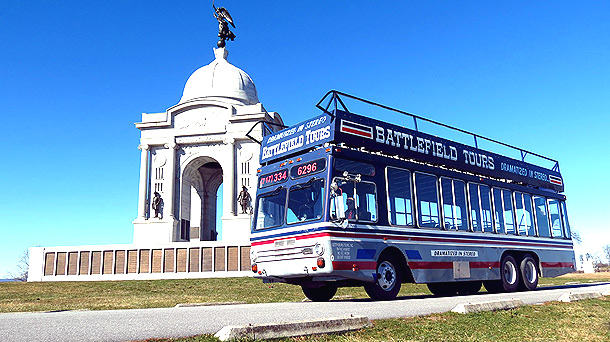 Spring begins this weekend and soon our bus tours will be out in full force leading numerous history enthusiasts throughout the Gettysburg Battlefield. Traveling the historic fields of Gettysburg with one of our friendly licensed battlefield guides provides visitors with a unique experience that brings history to life.
We often get a few questions about our tours, so we decided to put together this quick Q&A section to hopefully cover anything you may want to ask. We hope you find this list helpful as well.
- How long are the Gettysburg bus tours?
- Our bus tours are two hours and board five minutes before the scheduled time. Departure is from the Gettysburg Tour Center at 778 Baltimore Street, which is across from the National Cemetery.
- What do the bus tours cover, and what do we see?
- On your trip we will cover all three days of battle as we travel through the Gettysburg Battlefield.
- Do you get off the bus during your tour?
- We make at least one restroom and refreshment stop. If you’ve chosen one of our licensed guided tours we leave the scenic stop option up to your guide to determine where it will be. Sometimes you may make more than one scenic stop. If you choose the dramatized audio bus tour, your scenic stop will be at Little Round Top.
- Where can I book a tour?
- Reservations can be made by calling our toll free number at 877-680-8687. You can also purchase them online through our “Schedule a Tour” link above that takes you to a helpful calendar that lists all the tours that are available.
- Do you offer group tours (for schools, teams, organizations, etc)?
- We certainly do! Group tours can be booked through Gettysburg Group Reservations at 800-447-8788. You can learn more through the “Plan Your Trip” link on our website.
- What are the different bus tour options?
- We offer three different types of bus touring options. These include the licensed guided bus tour (in an enclosed bus with heat or air-conditioning depending on the time of year), a licensed guided double decker tour (weather permitting), or a dramatized audio bus tour (weather permitting on our famous double decker tour bus).
We hope this list covers all of the questions you may have had about Gettysburg Bus Tours, but we also understand you may have more. If any of your questions remain unanswered feel free to leave a comment below or contact us and we’ll be happy to answer them for you!
26th North Carolina Infantry
March 10, 2016Many visitors that come to Gettysburg question why there are so few confederate markers on the field. There are a number of reasons – #1 it was a confederate defeat #2 after the war the South was unable to financially channel many funds toward memorials and #3 the North plain & simple really didn’t want them here.
One of the few markers here at Gettysburg that honors Confederate soldiers can be found on Meredith Ave. in Reynold’s Woods & belongs to the 26th North Carolina Infantry. Engaged with the Union Iron Brigade on July 1st, this unit suffered very heavy casualties. They would lose a total of 588 men which would be the greatest numeric loss of any Confederate unit during the battle. They would also participate in Pickett’s Charge on July 3rd & a companion marker can be found at the Angle which notes their position on that day.
Their memorials were dedicated on October 5, 1985.
Breakdown of Army Units for both North and South
February 12, 2016Sometimes the visitor to the battlefield has difficulty trying to grasp the sheer numbers of men that were here during the battle. Here is a breakdown of the army units for both North & South.
Union Confederate
Company
35-40 35-40
Regiment
@310 @340
Brigade
@1415 @1550
Division
@3875 @6775
Corps
@11,100 @22,000
Total at Gettysburg
@93,000 @75,000
John Buford Memorial
January 5, 2016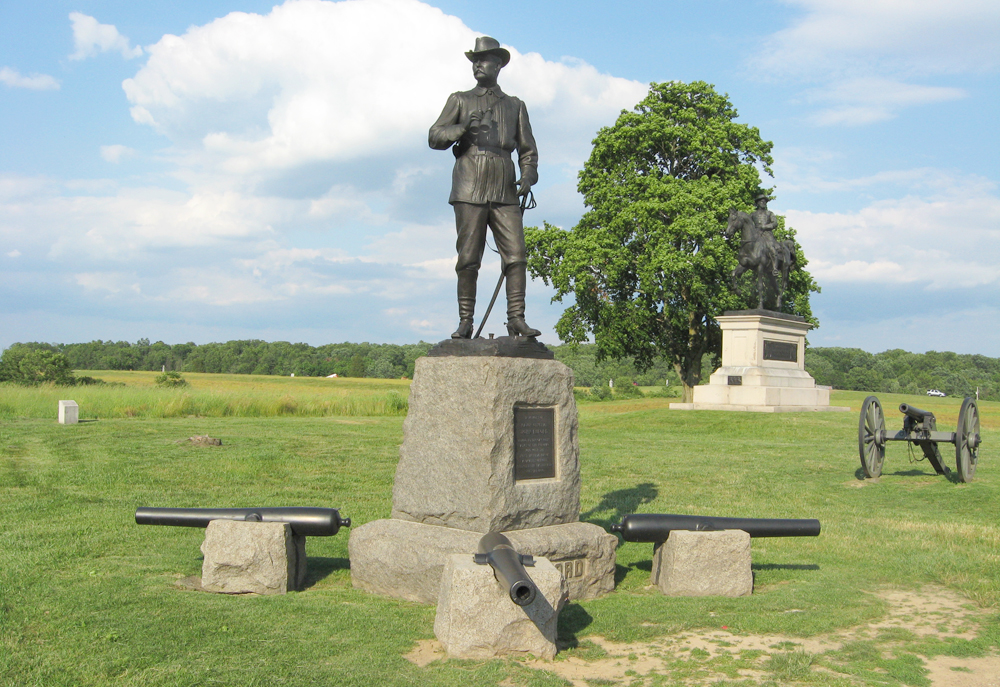
The cannon surrounding the monument are the actual pieces of Calef’s Battery, 2nd United States Artillery, Battery A. The barrel facing down Chambersburg Pike fired the first Union artillery shot of the battle under General Buford’s personal direction.
The three thousand cavalry troopers led by John Buford on the first day of Gettysburg were tasked with slowing down the Confederate advance long enough for Union reinforcements to arrive on the field. The combination of skill and luck used by General Buford successfully blunted the advance of Heth’s division on McPherson’s Ridge and contributed greatly to eventual Union victory at Gettysburg.
Born in Kentucky, General Buford’s promising military career was cut short when he came down with typhoid fever in the autumn of 1863. This illness resulted in his passing in December of the same year.
The Buford Memorial Association was formed in 1888 with the mission of erecting a suitable memorial on the field.
Located on the Chambersburg Pike, the John Buford Memorial was dedicated on July 1, 1895.
Surrounding the base are four Ordnance Rifles, the kind which were used in a Horse Artillery Battery. Among these guns is to be found number 233 and according to John Calef who commanded such a battery under Buford’s command, this was the gun that fired the very first Union artillery shot of the battle.
Portrait Statue of General Gouverneur K. Warren
October 6, 2015Known as the “Savior of Little Round Top”, the portrait statue of General Gouverneur K. Warren was dedicated on August 8, 1888 & was the first statue to a New York commander at Gettysburg.
The General is standing atop the boulder from which he noticed the Confederate advance on July 2nd. At the time, Little Round Top had been left almost completely unoccupied with the exception of a few signalmen who were preparing to leave. Recognizing the importance of the hill, General Warren instructed the signalmen to remain to give the impression of occupation while he sent aides off to secure immediate reinforcement. This prompt action allowed the hill to remain in Union hands.
All the funds needed for the construction of this memorial were privately raised.
New York State Monument
August 13, 2015In 1886 only two New York State monuments had been erected on the fields of Gettysburg. Those two being the 14th Brooklyn & the 124th New York with neither of these two representing the City of New York.
Veterans of the 83rd New York Infantry had a site chosen & a committee selected to watch over the construction – all they needed now were the funds to begin. Friends & survivors of the regiment were solicited for contributions & by Sept. 1887, almost $3500.00 had been collected.
Dedicated on July 1, 1888 – the monument to the 83rd New York was to become one of the single largest memorial dedications the battlefield would see. It was attended by veterans of the unit itself, plus other members of the First Corps, ranking officers from the battle & the entire 9th New York National Guard which was sent by the Governor of the State.
The memorial is a fifty-one foot tall shaft on levels of red & white granite. On top is a bronze cannonball & eagle. The eagle weighs in at 700 pounds & has a wing span of almost six feet.
The regimental badge can be found at the base with the motto “Ratione Aut Vi,” which means “By Reason or Force.”
Tennessee State Memorial
July 9, 2015The Tennessee State Memorial is the last of the southern states at Gettysburg to place a monument on the field. It is also the only state memorial built exclusively with private contributions.
Dedicated on July 2, 1982 at a cost of $25,000.00 this marker can be found on West Confederate Avenue.
Three Tennessee regiments took part in the battle & they are represented by the three soldiers etched into the face of the monument. Three stars on top symbolize the three geographic divisions of the state: eastern, central & western Tennessee. An outline of the State is cut into the 16 foot long base. Sixteen feet representing the fact that Tennessee was the 16th State to enter the Union.
John Burns Memorial
May 18, 2015On the afternoon of July 1, 1863, wearing a vest, dark coat & trousers & a high silk hat the only Gettysburg civilian known to have participated in the battle reported to Colonel Langhorne Wister of the 150th Pennsylvania Infantry & requested permission to join the fight. A veteran of the War of 1812, John Burns fought side by side with several Union regiments that day. His actions earned him the respect of the soldiers he fought alongside with. He was wounded three times & had to be carried from the field.
Burns recovered from his wounds & for the remaining years of his life was a local hero.
The Pennsylvania General Assembly elected to honor this man’s memory by erecting a memorial near the site of his service at the McPherson Farm.
The memorial was dedicated on July 1, 1903 & inscribed at the base are the words used by General Doubleday in his official report commending the heroism of this local citizen.
Dogs of Gettysburg
April 24, 2015
Dogs of Gettysburg is a unique combination of gifts for pets and their people. Go in and browse the many items in a Civil War inspired shop. We are sure you will find something to keep you and your pet happy. Our featured items include pet clothing, collars, leashes , beds and dog treats. Feel free to place an order for a custom Civil War Uniform and Kepi – Union or Confederate. In addition enjoy the many hand crafted items from local craftsman and the surrounding area. Pets are welcome ! They are located at 777 Baltimore Street suite 102 Gettysburg,Pa. 17325 across from the tour center. They are closed on Mondays and open from 10 am – 6 pm Tuesday, Wednesday, Thursday and 10 am- 7 pm Friday & Saturday open Sundays from 12 – 5 pm.
717-337-DOGS (717-337-3647)
Union Major General Daniel E. Sickles
April 13, 2015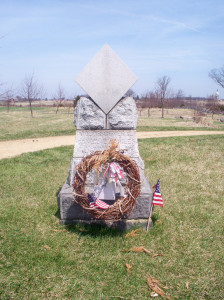 Union Major General Daniel E. Sickles is one of the most controversial figures at Gettysburg.
Commander of the Union 3rd Corps during the Gettysburg campaign, General Sickles was also a politician before & after the War Between the States.
On July 2, 1863, General Sickles was not at all happy with the position on the line that he was assigned. He felt the higher, more elevated ground to his front would be more defensible & offer his artillery a better field of fire. So, without authorization to do it; General Sickles moved his entire corps forward. This act unhinged the Union line & left the, now exposed, 3rd Corps vulnerable to attack from multiple directions & this is exactly what happened.
There are those who consider General Sickles the “Savior of Gettysburg” & there are those who view his acts as treasonous.
General Sickles was mounted, providing encouragement to his men on July 2nd when a 12 pound confederate cannon ball struck him on the right leg. The general’s horse was unhurt but, the injury would result in amputation for Sickles.
The small diamond shaped marker found on the grounds of the Trostle Farm was placed there in 1901 & marks the location of General Sickles’ wounding.